Titian

 Tiziano Vecellio, better known as Titian, the
leader of the 16th-century Venetian school of the Italian High/Late
Renaissance, and the greatest Venetian artist of the
16th century, the shaper of the Venetian coloristic and painterly
tradition. Titian contributed to all of the major areas of Renaissance
art, painting altarpieces, portraits, mythologies, and pastoral
landscapes. He is one of the key figures in the history of Western
art. His work, which permanently affected the course of European
painting, provided an alternative, of equal power and attractiveness,
to the linear and sculptural Florentine tradition championed by
Michelangelo and Raphael; this
alternative, eagerly taken up by Rubens, Diego Velazquez, Rembrandt, Eugene Delacroix, and the Impressionists, is
still vital today. In its own right Titian's work often attains the
very highest reach of human achievement in the visual arts.
Tiziano Vecellio, better known as Titian, the
leader of the 16th-century Venetian school of the Italian High/Late
Renaissance, and the greatest Venetian artist of the
16th century, the shaper of the Venetian coloristic and painterly
tradition. Titian contributed to all of the major areas of Renaissance
art, painting altarpieces, portraits, mythologies, and pastoral
landscapes. He is one of the key figures in the history of Western
art. His work, which permanently affected the course of European
painting, provided an alternative, of equal power and attractiveness,
to the linear and sculptural Florentine tradition championed by
Michelangelo and Raphael; this
alternative, eagerly taken up by Rubens, Diego Velazquez, Rembrandt, Eugene Delacroix, and the Impressionists, is
still vital today. In its own right Titian's work often attains the
very highest reach of human achievement in the visual arts.
Late art of
...Titian
> analysis of art, paintings, and works...
- Venus of Urbino (Detail) (1538)
- Portrait of Francesco Maria della Rovere (1538)
- Eleonora Gonzaga (1538)
- The Venus of Urbino (1538)
- Portrait of Francis I (1539)
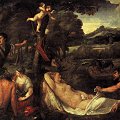
- Jupiter and Antiope (Pardo Venus) (1540)
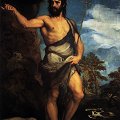
- St. John the Baptist in the Desert (1542)
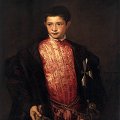
- Portrait of Ranuccio Farnese (1542)
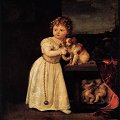
- Portrait of Clarissa Strozzi (1542)
- Crowning with Thorns (1542)
- The Resurrection (1544)
- Sacrifice of Isaac (1544)
- David and Goliath (1544)
- Portrait of Doge Andrea Gritti (1545)
- Portrait of a Girl (1545)
- Cardinal Alessandro Farnese (1546)
- Portrait of Count Antonio Porcia (1548)
- Venus with the Organ Player (1550)
- Portrait of Isabella of Portugal (1548)
- Portrait of Charles V Seated (1548)
- Sisyphus (1549)
- Portrait of Philip II in Armour (1551)
- Man in Military Costume (1552)
- Portrait of Philip II (1554)
- Venus and Adonis (1554)
- Crucifixion (1555)
- Mater Dolorosa (1555)
- Portrait of the Doge Francesco Venier (1556)
- Entombment (1559)
- Diana and Callisto (1559)
- Portrait of a Man with a Palm (1561)
- Self-Portrait (1562)
- Death of Actaeon (1562)
- Venus Blindfolding Cupid (1565)
- Penitent St. Mary Magdalene (1565)
- Christ and the Good Thief (1566)
- Spain Succouring Religion (1575)
- Philip II Offering Don Fernando to Victory (1575)
- Crowning with Thorns (1576)
- Pieta (1576)
- The Flaying of Marsyas (1576)
- Doge Antonio Grimani Kneeling Before the Faith (1576)
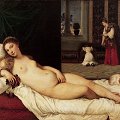
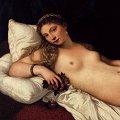
Venus of Urbino (Detail) (1538)
 Get
Get  a high-quality picture of
Venus of Urbino (Detail) for your computer or notebook. ‣
In the corner of the room two servant-girls are perhaps looking for
some garment - their presence in the picture being an excuse for the artist
to create a sense of homeliness by means of what seems to be a workaday
scene. Their gestures fairly vibrate in the light pouring in at the
window, engendering a near-musical effect in the background, and enhancing
the vital inner sparkle of Venus' nude body.
a high-quality picture of
Venus of Urbino (Detail) for your computer or notebook. ‣
In the corner of the room two servant-girls are perhaps looking for
some garment - their presence in the picture being an excuse for the artist
to create a sense of homeliness by means of what seems to be a workaday
scene. Their gestures fairly vibrate in the light pouring in at the
window, engendering a near-musical effect in the background, and enhancing
the vital inner sparkle of Venus' nude body.
The dog, the roses held by Venus, and the myrtle plant on the window ledge are all symbols of the constancy of love.
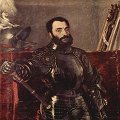
Portrait of Francesco Maria della Rovere (1538)
 Get a high-quality picture of
Portrait of Francesco Maria della Rovere for your computer or notebook. ‣
Francesco Maria della Rovere (1490-1538) succeeded his uncle Guidobaldo
da Montefeltre as ruler of Urbino. Though at first protected by his uncle
Pope Julius II (Giuliano della Rovere), he lost power under the Medici
Pope Leo X, but was able to regain his territories after his death. He was
one of Italy's most important military leaders and frequently served the
Republic of Venice.
Get a high-quality picture of
Portrait of Francesco Maria della Rovere for your computer or notebook. ‣
Francesco Maria della Rovere (1490-1538) succeeded his uncle Guidobaldo
da Montefeltre as ruler of Urbino. Though at first protected by his uncle
Pope Julius II (Giuliano della Rovere), he lost power under the Medici
Pope Leo X, but was able to regain his territories after his death. He was
one of Italy's most important military leaders and frequently served the
Republic of Venice.
Perhaps because of the limitations of the court-portrait, perhaps also because he had not his sitter actually present - we know that the latter dispatched his armour to the painter at Venice with the request that he should hurry on the work - this portrait, although impassioned and full of pride, lacks something of the spiritual profundity of many others by the artist.
In creating a pair of paintings of Francesco Maria della Rovere and Eleonora Gonzaga, duke and duchess of Urbino, Titian predictably reprised many of the themes seen in Piero della Francesca's double portrait of their predecessors, Federico da Montefeltre and Battista Sforza. Once again, the male portrait is more rugged and individualized, emphasizing military exploits and adventures. Francesco Maria poses alert in his stunningly rendered, glinting armor, his right arm and baton dramatically thrust out into the viewer's space. Behind him a splendid, plumed parade helmet, reflecting the vibrant, pulsating red of a velvet drape, faces a jauntily angled set of lances. In marked contrast, Eleonora Gonzaga sits primly in her chair, immobile within her highly detailed but much less lovingly depicted court dress. Her pet dog lies bored on a table in front of a window. Titian's landscape is expansive but untraversible, marked by a church tower in its idealized blue distance.
Francesco Maria della Rovere (1490-1538) succeeded his uncle Guidobaldo da Montefeltre as ruler of Urbino. Though at first protected by his uncle Pope Julius II (Giuliano della Rovere), he lost power under the Medici Pope Leo X, but was able to regain his territories after his death. He was one of Italy's most important military leaders and frequently served the Republic of Venice.
Eleonora Gonzaga (1538)
 Get a high-quality picture of
Eleonora Gonzaga for your computer or notebook. ‣
In creating a pair of paintings of Francesco Maria della Rovere and
Eleonora Gonzaga, duke and duchess of Urbino, Titian predictably reprised
many of the themes seen in Piero della Francesca's double portrait of
their predecessors, Federico da Montefeltre and Battista Sforza. Once
again, the male portrait is more rugged and individualized, emphasizing
military exploits and adventures. Francesco Maria poses alert in his
stunningly rendered, glinting armor, his right arm and baton dramatically
thrust out into the viewer's space. Behind him a splendid, plumed parade
helmet, reflecting the vibrant, pulsating red of a velvet drape, faces a
jauntily angled set of lances. In marked contrast, Eleonora Gonzaga sits
primly in her chair, immobile within her highly detailed but much less
lovingly depicted court dress. Her pet dog lies bored on a table in front
of a window. Titian's landscape is expansive but untraversible, marked by
a church tower in its idealized blue distance.
Get a high-quality picture of
Eleonora Gonzaga for your computer or notebook. ‣
In creating a pair of paintings of Francesco Maria della Rovere and
Eleonora Gonzaga, duke and duchess of Urbino, Titian predictably reprised
many of the themes seen in Piero della Francesca's double portrait of
their predecessors, Federico da Montefeltre and Battista Sforza. Once
again, the male portrait is more rugged and individualized, emphasizing
military exploits and adventures. Francesco Maria poses alert in his
stunningly rendered, glinting armor, his right arm and baton dramatically
thrust out into the viewer's space. Behind him a splendid, plumed parade
helmet, reflecting the vibrant, pulsating red of a velvet drape, faces a
jauntily angled set of lances. In marked contrast, Eleonora Gonzaga sits
primly in her chair, immobile within her highly detailed but much less
lovingly depicted court dress. Her pet dog lies bored on a table in front
of a window. Titian's landscape is expansive but untraversible, marked by
a church tower in its idealized blue distance.
The Venus of Urbino (1538)
Get a high-quality picture of
The Venus of Urbino for your computer or notebook. ‣
The Venus of Urbino was painted for Guidobaldo della Rovere,
the heir of Francesco Maria della Rovere, Duke of Urbino. If the pose
of this Venus brings to mind that of Giorgione's Sleeping Venus in
Dresden (which the young Titian had completed after Giorgione's death)
the intent of the painting is quite different. Titian's Venus has
nothing to do with Giorgione's idealised image of female beauty, it is
normally interpreted as an allegory of marital love. There have been
some suggestions that there might be a connection with the wedding of
Guidobaldo della Rovere and Giuliana Varano in 1534.
This is an extremely fine composition. It invites us to dwell on more than just the warm, golden figure of this young woman with her cascading curls and the attractive, carefully studied movement of her arm. Observe the way the sheet has been painted, with masterful blends of colour, the small dog lazily curled up asleep, the amusing touch of the two maids rummaging in the chest, the world outside the window, and the malicious, but at the same time ingenious expression of the young Venus. There is an intimacy of this scene of almost domestic simplicity which places the whole composition in a warm, human, temporal reality.
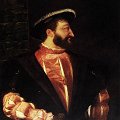
Portrait of Francis I (1539)
 Get a high-quality picture of
Portrait of Francis I for your computer or notebook. ‣
Titian never saw Francis I, the king of France (1494-1547). He
nonetheless succeeded in painting an impressive portrait of a ruler. The
model for his portrait was a medal made by Benvenuto Cellini,
showing the king in profile. The erect posture, broad torso and
magnificent garments give the portrait a regal air. The flat hat with its
delicate feathers, together with his fine hair, which is brushed across
his face in a similarly feathery way, give a certain lightness to the
otherwise very proud royal portrait.
Get a high-quality picture of
Portrait of Francis I for your computer or notebook. ‣
Titian never saw Francis I, the king of France (1494-1547). He
nonetheless succeeded in painting an impressive portrait of a ruler. The
model for his portrait was a medal made by Benvenuto Cellini,
showing the king in profile. The erect posture, broad torso and
magnificent garments give the portrait a regal air. The flat hat with its
delicate feathers, together with his fine hair, which is brushed across
his face in a similarly feathery way, give a certain lightness to the
otherwise very proud royal portrait.
Jupiter and Antiope (Pardo Venus) (1540)
 Get a high-quality picture of
Jupiter and Antiope (Pardo Venus) for your computer or notebook. ‣
In 1574, Titian described this painting in a letter to the secretary of
Philip II as being "the naked woman with the landscape and satyr". Its
present name, Pardo Venus, derived from the Spanish palace of El Pardo,
where the painting was for a long time kept. The reclining naked figure
was interpreted as a Venus. In fact, the painting depicts the moment when
Jupiter, in the form of a satyr, approached Antiope, a king's daughter,
who will give birth to twins.
Get a high-quality picture of
Jupiter and Antiope (Pardo Venus) for your computer or notebook. ‣
In 1574, Titian described this painting in a letter to the secretary of
Philip II as being "the naked woman with the landscape and satyr". Its
present name, Pardo Venus, derived from the Spanish palace of El Pardo,
where the painting was for a long time kept. The reclining naked figure
was interpreted as a Venus. In fact, the painting depicts the moment when
Jupiter, in the form of a satyr, approached Antiope, a king's daughter,
who will give birth to twins.
The representation of the nude woman shows the direct influence of Giorgione's Venus in Dresden. Titian never painted independent landscapes, however, the landscape plays an important role in his paintings when the subject allows it.
St. John the Baptist in the Desert (1542)
 Get a high-quality picture of
St. John the Baptist in the Desert for your computer or notebook. ‣
Even more than in his Presentation of the Virgin at the Temple,
Titian's attempt to fill out his chromatic language with Mannerist elements
is clearly evident in this work painted for the now demolished church of
Santa Maria Maggiore. The overpowering plasticity of the figure, its
theatrical pose, and the strength of the timbres of the tones all reflect
the dominant taste of the fifth decade of the sixteenth century in a
Venice which was increasingly concerned with the problems of form and
composition that preoccupied the 'classicists' of Central Italy, ideas
that were propagated in Venice by Jacopo Sansovino, Vasari and Salviati.
Get a high-quality picture of
St. John the Baptist in the Desert for your computer or notebook. ‣
Even more than in his Presentation of the Virgin at the Temple,
Titian's attempt to fill out his chromatic language with Mannerist elements
is clearly evident in this work painted for the now demolished church of
Santa Maria Maggiore. The overpowering plasticity of the figure, its
theatrical pose, and the strength of the timbres of the tones all reflect
the dominant taste of the fifth decade of the sixteenth century in a
Venice which was increasingly concerned with the problems of form and
composition that preoccupied the 'classicists' of Central Italy, ideas
that were propagated in Venice by Jacopo Sansovino, Vasari and Salviati.
But even in this muscular athlete (certainly no hermit emaciated by exhausting fast) the formal academic quality of Mannerism is redeemed by Titian's sensitivity to colour: the 'impasto' of the paint seems almost to be rising in the luminous matching of the grey of the skin to the ivory colour of the flesh and in the browns, greens and darkened by the rushing torrent. Indeed it was precisely because of his feeling for colour that in Titian the formulae of Mannerism, instead of crystallizing in abstract programmatic projects, was translated into an enthusiasm for research.
Portrait of Ranuccio Farnese (1542)
 Get a high-quality picture of
Portrait of Ranuccio Farnese for your computer or notebook. ‣
Ranuccio Farnese (1530-1565) was the son of Pier Luigi Farnese, the son
of Pope Paul III. He came to Venice in 1542 to be the prior of San
Giovanni dei Forlani, which belonged to the Knights of Malta. The white
cross on his cloak clearly shows that he is a member of the order. Only
twelve years old, Ranuccio already possess the grave bearing of an adult.
The way he is looking out to the left of the picture, and the slight
turning of his body, makes him look as if he is about to move from the
place where the artist has captured him on canvas. This movement
contributes considerably to the impression of childlike freshness which
the painting radiates.
Get a high-quality picture of
Portrait of Ranuccio Farnese for your computer or notebook. ‣
Ranuccio Farnese (1530-1565) was the son of Pier Luigi Farnese, the son
of Pope Paul III. He came to Venice in 1542 to be the prior of San
Giovanni dei Forlani, which belonged to the Knights of Malta. The white
cross on his cloak clearly shows that he is a member of the order. Only
twelve years old, Ranuccio already possess the grave bearing of an adult.
The way he is looking out to the left of the picture, and the slight
turning of his body, makes him look as if he is about to move from the
place where the artist has captured him on canvas. This movement
contributes considerably to the impression of childlike freshness which
the painting radiates.
This portrait is important in the artist's career for it marks the beginning of Titian's long association with the Farnese family and especially with Pope Paul III.
Portrait of Clarissa Strozzi (1542)
 Get a high-quality picture of
Portrait of Clarissa Strozzi for your computer or notebook. ‣
Clarissa Strozzi was the daughter of Roberto Strozzi and Maddalena dei
Medici, who lived in exile in Venice from 1540 to 1542. Along with the
portrait of Ranuccio Farnese, this painting is the second enchanting
child's portrait Titian painted in 1542. Clarissa is feeding her little
dog, but, like Ranuccio, is looking at something taking place outside the
picture. This again creates a vivid sense of movement. The putti on the
relief emphasize Clarissa's childlike vitality.
Get a high-quality picture of
Portrait of Clarissa Strozzi for your computer or notebook. ‣
Clarissa Strozzi was the daughter of Roberto Strozzi and Maddalena dei
Medici, who lived in exile in Venice from 1540 to 1542. Along with the
portrait of Ranuccio Farnese, this painting is the second enchanting
child's portrait Titian painted in 1542. Clarissa is feeding her little
dog, but, like Ranuccio, is looking at something taking place outside the
picture. This again creates a vivid sense of movement. The putti on the
relief emphasize Clarissa's childlike vitality.
Crowning with Thorns (1542)
 Get a high-quality picture of
Crowning with Thorns for your computer or notebook. ‣
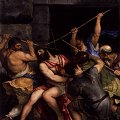
In the Crowning with Thorns, painted for the church of Santa Maria
delle Grazie in Milan, the space is compressed in the scene by arranging
the figures on a shallow plane delimited by the wall of a building. There
are explicit references to antiquity: the figure of Christ derives from
the celebrated Laocoon, an antique statue
discovered in Rome in 1506, an archetypal exemplum doloris ("example of
pain"). Another famous antique sculptural fragment, the Belvedere Torso,
provides the model for the upper body of the torturer on the left. With
the inclusion of the bust of Tiberius Caesar, a direct reference to the
Roman authorities who condemned Christ, Titian also pays homage to the
classical past.
Get a high-quality picture of
Crowning with Thorns for your computer or notebook. ‣
In the Crowning with Thorns, painted for the church of Santa Maria
delle Grazie in Milan, the space is compressed in the scene by arranging
the figures on a shallow plane delimited by the wall of a building. There
are explicit references to antiquity: the figure of Christ derives from
the celebrated Laocoon, an antique statue
discovered in Rome in 1506, an archetypal exemplum doloris ("example of
pain"). Another famous antique sculptural fragment, the Belvedere Torso,
provides the model for the upper body of the torturer on the left. With
the inclusion of the bust of Tiberius Caesar, a direct reference to the
Roman authorities who condemned Christ, Titian also pays homage to the
classical past.
This is a brutal scene, in which Christ's tormentors twist the crown onto his head with their canes, but the violence is relieved and Christ's suffering exalted by the beauty of the colours, which especially in the blue and green to the right are colder than usual in deference to Titian's Roman sources. In Christ's foot extended on the steps, however, Titian pulls out all the Venetian stops and one can sense the blood flowing through the veins under the flesh. The pattern of the canes slices through the massed figures like the strokes of a knife, forming a Trinitarian triangle to the right of Christ's head. An inimitable Titian touch is the cane lying unused on the foremost step, still, shadowless and deadly, like a snake.
The Resurrection (1544)
 Get a high-quality picture of
The Resurrection for your computer or notebook. ‣
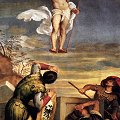
This painting was originally part of a processional banner for the
Corpus Domini brotherhood in Urbino. Documents relating to payments made
in 1542 and 1544 still exist. As early as 1546, the banner was split. Here,
Titian is repeating the composition of the Polyptych of the Resurrection.
The greater range of colours, however, is typical of his work shortly
after 1540, even though both sections of the banner would have been
produced with the assistance of his workshop.
Get a high-quality picture of
The Resurrection for your computer or notebook. ‣
This painting was originally part of a processional banner for the
Corpus Domini brotherhood in Urbino. Documents relating to payments made
in 1542 and 1544 still exist. As early as 1546, the banner was split. Here,
Titian is repeating the composition of the Polyptych of the Resurrection.
The greater range of colours, however, is typical of his work shortly
after 1540, even though both sections of the banner would have been
produced with the assistance of his workshop.
Sacrifice of Isaac (1544)
 Get a high-quality picture of
Sacrifice of Isaac for your computer or notebook. ‣
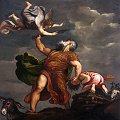
Titian executed three ceiling paintings (Sacrifice of Isaac; Cain and
Abel; David and Goliath) for the ceiling of the church Santo Spirito in
Isola (now they are in the sacristy of Santa Maria della Salute in
Venice). These paintings are characterized by the spiraling movement of the
figures, the counterpoised poses and the strong intersecting diagonals. In
these canvases we see Titian's Mannerism at its height.
Get a high-quality picture of
Sacrifice of Isaac for your computer or notebook. ‣
Titian executed three ceiling paintings (Sacrifice of Isaac; Cain and
Abel; David and Goliath) for the ceiling of the church Santo Spirito in
Isola (now they are in the sacristy of Santa Maria della Salute in
Venice). These paintings are characterized by the spiraling movement of the
figures, the counterpoised poses and the strong intersecting diagonals. In
these canvases we see Titian's Mannerism at its height.
Following St Augustine's and St Paul's suggestion, Isaac is seen as an image for Christ's own sacrifice. The supreme acceptance of Abraham is the equivalent of justification by faith.
David and Goliath (1544)
 Get a high-quality picture of
David and Goliath for your computer or notebook. ‣
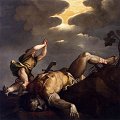
Titian executed three ceiling paintings (Sacrifice of Isaac; Cain and
Abel; David and Goliath) for the ceiling of the church Santo Spirito in
Isola (now they are in the sacristy of Santa Maria della Salute in
Venice). These paintings are characterized by the spiraling movement of the
figures, the counterpoised poses and the strong intersecting diagonals. In
these canvases we see Titian's Mannerism at its height.
Get a high-quality picture of
David and Goliath for your computer or notebook. ‣
Titian executed three ceiling paintings (Sacrifice of Isaac; Cain and
Abel; David and Goliath) for the ceiling of the church Santo Spirito in
Isola (now they are in the sacristy of Santa Maria della Salute in
Venice). These paintings are characterized by the spiraling movement of the
figures, the counterpoised poses and the strong intersecting diagonals. In
these canvases we see Titian's Mannerism at its height.
Titian uses a very unusual iconography in this painting. David prays after defeating the Philistine giant, and the leaden sky is rent by the light of grace.
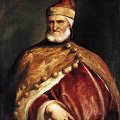
Portrait of Doge Andrea Gritti (1545)
 Get a high-quality picture of
Portrait of Doge Andrea Gritti for your computer or notebook. ‣
Titian's portraits provide a gallery of the leading aristocrats of
Italy. Most of these works are essentially idealized state portraits,
although the heads are very convincingly rendered. Doge Andrea Gritti is
to a greater extent a symbol of the office - that is, that of ruler of
Venice. The gigantic body in a canvas of large size is sweeping in design
and commanding in presence.
Get a high-quality picture of
Portrait of Doge Andrea Gritti for your computer or notebook. ‣
Titian's portraits provide a gallery of the leading aristocrats of
Italy. Most of these works are essentially idealized state portraits,
although the heads are very convincingly rendered. Doge Andrea Gritti is
to a greater extent a symbol of the office - that is, that of ruler of
Venice. The gigantic body in a canvas of large size is sweeping in design
and commanding in presence.
The fine harmony of the reds and golds, and the upward sweep from the bottom left of the open brocade cloak, whose strong lines end at the top of the Doge's hat, give this painting a sense of power and glory. The Doge's severe gaze, signaling his strength and determination, deepen this impression. For stylistic reasons it is nowadays assumed that this portrait was not painted until about 1545, long after Gritti's death in 1538.
Portrait of a Girl (1545)
 Get a high-quality picture of
Portrait of a Girl for your computer or notebook. ‣
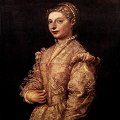
The young girl in this small painting has frequently been identified as
Titian's daughter, Lavinia. But there is little to support this claim
apart from the blonde hair. Its interpretation as Clelia Farnese, which
would mean that the painting was commissioned by a member of Pope Paul
III's family, is given little credence by scholars. It has even been
disputed whether this is an original work by Titian, or whether it is an
imitation painted by another talented artist. What is certain is that the
painting, with the delightful play of pale pink and light golds, would
have been painted by a member of Titian's circle.
Get a high-quality picture of
Portrait of a Girl for your computer or notebook. ‣
The young girl in this small painting has frequently been identified as
Titian's daughter, Lavinia. But there is little to support this claim
apart from the blonde hair. Its interpretation as Clelia Farnese, which
would mean that the painting was commissioned by a member of Pope Paul
III's family, is given little credence by scholars. It has even been
disputed whether this is an original work by Titian, or whether it is an
imitation painted by another talented artist. What is certain is that the
painting, with the delightful play of pale pink and light golds, would
have been painted by a member of Titian's circle.
Cardinal Alessandro Farnese (1546)
 Get a high-quality picture of
Cardinal Alessandro Farnese for your computer or notebook. ‣
Alessandro Farnese (1520-1589) was the son of Pier Luigi Farnese and
the grandson of Pope Paul III. Though he was showered with ecclesiastical
honors by his grandfather, he did not succeed in becoming pope when Paul
died in 1549. Nonetheless, he continued to exert considerable influence on
Roman politics until his death, and was in addition, a particularly
important patron of the arts.
Get a high-quality picture of
Cardinal Alessandro Farnese for your computer or notebook. ‣
Alessandro Farnese (1520-1589) was the son of Pier Luigi Farnese and
the grandson of Pope Paul III. Though he was showered with ecclesiastical
honors by his grandfather, he did not succeed in becoming pope when Paul
died in 1549. Nonetheless, he continued to exert considerable influence on
Roman politics until his death, and was in addition, a particularly
important patron of the arts.
Portrait of Count Antonio Porcia (1548)
 Get a high-quality picture of
Portrait of Count Antonio Porcia for your computer or notebook. ‣
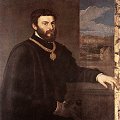
A magnificent work of Titian's early maturity, this is certainly
one of his greatest portraits. The half-figure in three-quarter view
is shown beside a window open on a distant landscape whose high-keyed
harmonies contrast with the low tones of the interior in the
foreground. The figure is stylistically akin to Titian's portrait of
Francesco Maria della Rovere, which is now in the Uffizi.
Get a high-quality picture of
Portrait of Count Antonio Porcia for your computer or notebook. ‣
A magnificent work of Titian's early maturity, this is certainly
one of his greatest portraits. The half-figure in three-quarter view
is shown beside a window open on a distant landscape whose high-keyed
harmonies contrast with the low tones of the interior in the
foreground. The figure is stylistically akin to Titian's portrait of
Francesco Maria della Rovere, which is now in the Uffizi.
Venus with the Organ Player (1550)
 Get a high-quality picture of
Venus with the Organ Player for your computer or notebook. ‣
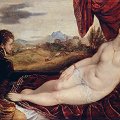
The great Venetian master created several paintings depicting the
nude Venus in the company of male musicians. Each of these works has
multiple allegorical meanings. In this picture the connection between
music and love can be sensed even more directly than in earlier
astrological illustrations. Painters have characterized the children
of Venus (that is, those who were born under the sign of Taurus the
Bull or Libra the Scales) with scenes of love-making and other earthly
pleasures: games, feasts, bathing, dancing, excursions, and especially
music-playing. From the complex astrological series of the sixteenth
century developed the picture type "Venus with Musician", then the
amorous scenes and pastoral concerts which remained fashionable for
another two hundred years.
Get a high-quality picture of
Venus with the Organ Player for your computer or notebook. ‣
The great Venetian master created several paintings depicting the
nude Venus in the company of male musicians. Each of these works has
multiple allegorical meanings. In this picture the connection between
music and love can be sensed even more directly than in earlier
astrological illustrations. Painters have characterized the children
of Venus (that is, those who were born under the sign of Taurus the
Bull or Libra the Scales) with scenes of love-making and other earthly
pleasures: games, feasts, bathing, dancing, excursions, and especially
music-playing. From the complex astrological series of the sixteenth
century developed the picture type "Venus with Musician", then the
amorous scenes and pastoral concerts which remained fashionable for
another two hundred years.
In Titian's painting the contact between the enamoured youth and the goddess reveals something else, too. The canvas is dominated by the reclining nude figure on the couch casually leaning on her elbow and personifying beauty with her full body and the vibrant liveliness of her skin. The organ-player has his back toward her, but he openly turns his head while playing and derives inspiration from the sight of such beauty. This is a clear presentation of the inspiration theme in which Venus fulfills the role of the Muse. Her demeanour is ceremonial and passive; she pays no attention to the musician while he - and this is similar in each variant - makes great effort to make eye contact. It appears as if he pays reverence to such physical beauty by playing his music.
In addition, this painting can be considered the representation of Sight and Hearing. The active role of the glance and the importance of vision refer to the first sense, while the music-playing to the second. We can also assume that the stag running across the background became part of this picture in connection with Hearing, while the well, decorated with the figure of a faun holding an urn, is the well-spring of love.
Portrait of Isabella of Portugal (1548)
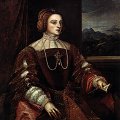 Get a high-quality picture of
Portrait of Isabella of Portugal for your computer or notebook. ‣
The painting, commissoned by Emperor Charles V, was executed in
Augsburg in 1548. Isabella of Portugal (1503-1539) married Emperor Charles
V in 1526. She died very young, when she was only 36, and long before
Charles V commissioned Titian to paint her portrait. Her pale face
emphasizes her gentleness, which is also visible in the slender fingers of
her hands. The entire portrait is centred around a superb colour harmony
of the red, white and gold. A charming colour contrast is provided by the
blue and green tints of the landscape, and the eyes of the empress.
Get a high-quality picture of
Portrait of Isabella of Portugal for your computer or notebook. ‣
The painting, commissoned by Emperor Charles V, was executed in
Augsburg in 1548. Isabella of Portugal (1503-1539) married Emperor Charles
V in 1526. She died very young, when she was only 36, and long before
Charles V commissioned Titian to paint her portrait. Her pale face
emphasizes her gentleness, which is also visible in the slender fingers of
her hands. The entire portrait is centred around a superb colour harmony
of the red, white and gold. A charming colour contrast is provided by the
blue and green tints of the landscape, and the eyes of the empress.
Portrait of Charles V Seated (1548)
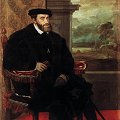 Get a high-quality picture of
Portrait of Charles V Seated for your computer or notebook. ‣
At the beginning of 1548 Titian left Venice for Augsburg where he met
Charles V, fresh from his great victory over the Protestant League at
Mohlberg. At Augsburg (where he remained until October 1548) he was kept
busy painting, chiefly, portraits of the Emperor and important members of
his court.
Get a high-quality picture of
Portrait of Charles V Seated for your computer or notebook. ‣
At the beginning of 1548 Titian left Venice for Augsburg where he met
Charles V, fresh from his great victory over the Protestant League at
Mohlberg. At Augsburg (where he remained until October 1548) he was kept
busy painting, chiefly, portraits of the Emperor and important members of
his court.
Like the painting representing the Emperor at Mohlberg, this portrait was painted during the imperial Diet of Augsburg in 1548. It is, however, thought that Titian did not create the work single-handedly. There is an awkwardness in the foreshortening of the perspective of the chair; and the red carpet is an isolated colour contrast, very unusual in Titian's work. But there are also areas of high quality. The face, above all, demonstrates a fine power of observation. The deformation of Charles' lower jaw has been skillfully concealed. The intimate atmosphere of the painting, which contains no regal affectations, is unusual in Titian's portraits of rulers.
Sisyphus (1549)
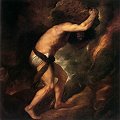 Get a high-quality picture of
Sisyphus for your computer or notebook. ‣
Titian painted four large canvases of the Damned for Mary of Hungary,
Charles V's sister and his regent in the Netherlands. They depicted
Tityus, Sisyphus, Tantalus and Ixion, all condemned to perpetual torture
for incurring the displeasure of the gods. Only Tityus and Sisyphus are
still extant. Tityus was sentenced to have his liver perpetually devoured
by a vulture for having raped Latona and Sisyphus to carry a rock
endlessly up hill for gossiping about Zeus's affair with Egira. Their
gigantism is Michelangelesque, and Tityus is modeled on a Michelangelo
drawing of 1532. In these two canvases, Titian achieves rich effects of
colour and chiaroscuro with a limited palette in a foretaste of his late
style.
Get a high-quality picture of
Sisyphus for your computer or notebook. ‣
Titian painted four large canvases of the Damned for Mary of Hungary,
Charles V's sister and his regent in the Netherlands. They depicted
Tityus, Sisyphus, Tantalus and Ixion, all condemned to perpetual torture
for incurring the displeasure of the gods. Only Tityus and Sisyphus are
still extant. Tityus was sentenced to have his liver perpetually devoured
by a vulture for having raped Latona and Sisyphus to carry a rock
endlessly up hill for gossiping about Zeus's affair with Egira. Their
gigantism is Michelangelesque, and Tityus is modeled on a Michelangelo
drawing of 1532. In these two canvases, Titian achieves rich effects of
colour and chiaroscuro with a limited palette in a foretaste of his late
style.
Portrait of Philip II in Armour (1551)
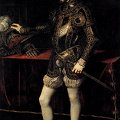 Get a high-quality picture of
Portrait of Philip II in Armour for your computer or notebook. ‣
Philip II (1527-1598) was the only son of Charles V and Isabella of
Portugal. In 1551, following the imperial Diet of Augsburg, he became the
regent of Spain. After his father's abdication, he was crowned the king of
Spain. Titian portrays the prince, aged about twenty-four dressed in a
magnificent, lavishly decorated set of armour. The whiteness of his skin
corresponds to his white stockings and the greenish golden sheen on his
armour. In this way, the prince's pale complexion appears more
distinguished.
Get a high-quality picture of
Portrait of Philip II in Armour for your computer or notebook. ‣
Philip II (1527-1598) was the only son of Charles V and Isabella of
Portugal. In 1551, following the imperial Diet of Augsburg, he became the
regent of Spain. After his father's abdication, he was crowned the king of
Spain. Titian portrays the prince, aged about twenty-four dressed in a
magnificent, lavishly decorated set of armour. The whiteness of his skin
corresponds to his white stockings and the greenish golden sheen on his
armour. In this way, the prince's pale complexion appears more
distinguished.
Man in Military Costume (1552)
 Get a high-quality picture of
Man in Military Costume for your computer or notebook. ‣
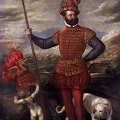
In the latter part of his career Titian continued to give much care to
portraits, though painting fewer. The most flamboyant is the Portrait of a
Man in Military Costume dateable to the early 1550s. He is portrayed so
theatrically that it is hard to take him seriously. Titian only adopted
the full-length format for clients of the highest rank and surprisingly in
so swagger an image the sitter has escaped identification. His outfit also
needs to be better understood since it seems halfway between a military
and a hunting costume.
Get a high-quality picture of
Man in Military Costume for your computer or notebook. ‣
In the latter part of his career Titian continued to give much care to
portraits, though painting fewer. The most flamboyant is the Portrait of a
Man in Military Costume dateable to the early 1550s. He is portrayed so
theatrically that it is hard to take him seriously. Titian only adopted
the full-length format for clients of the highest rank and surprisingly in
so swagger an image the sitter has escaped identification. His outfit also
needs to be better understood since it seems halfway between a military
and a hunting costume.
The identity of the subject of this life-size painting is unknown, probably it represents Ferrante Gonzaga (1507-1557), a successful commander under Charles V and later viceroy of Sicily and governor of Milan. The Cupid fiddling with his magnificently decorated helmet sets the portrait in an allegorical-mythical context.
Portrait of Philip II (1554)
 Get a high-quality picture of
Portrait of Philip II for your computer or notebook. ‣
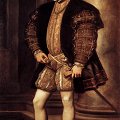
Most of this painting must be attributed to a particularly able member
of Titian's workshop. Here, the face of Philip II is made to appear
handsome. The entire method of painting is considerably more detailed than
in Titian's own Prado portrait of Philip, so it is thought that this
portrait was painted by an associate of Titian's from north of the Alps.
Philip II may well have been more satisfied with this version, as he had
complained to his aunt, Queen Mary of Hungary, about the imprecise
execution of his portrait.
Get a high-quality picture of
Portrait of Philip II for your computer or notebook. ‣
Most of this painting must be attributed to a particularly able member
of Titian's workshop. Here, the face of Philip II is made to appear
handsome. The entire method of painting is considerably more detailed than
in Titian's own Prado portrait of Philip, so it is thought that this
portrait was painted by an associate of Titian's from north of the Alps.
Philip II may well have been more satisfied with this version, as he had
complained to his aunt, Queen Mary of Hungary, about the imprecise
execution of his portrait.
Venus and Adonis (1554)
 Get a high-quality picture of
Venus and Adonis for your computer or notebook. ‣
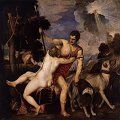
Between 1553 and 1554 Titian executed for the Habsburgs two
"mythological fables" of clearly erotic intent, the Danae and
the Venus and Adonis, both now in the Prado, Madrid. The
Venus and Adonis became the prototype for a whole series of
replicas of this subject.
Get a high-quality picture of
Venus and Adonis for your computer or notebook. ‣
Between 1553 and 1554 Titian executed for the Habsburgs two
"mythological fables" of clearly erotic intent, the Danae and
the Venus and Adonis, both now in the Prado, Madrid. The
Venus and Adonis became the prototype for a whole series of
replicas of this subject.
In both paintings the scene of the union of the lovers is bathed in the warm light of sunset, where the diffuse softness of the colours holds sway. The female nudes reveal the the continuing inspiration of Michelangelo's sculpture, such as the Dawn and Night from the Medici tombs in Florence. But what is entirely personal to Titian is the quality of the colour, which fragments into patches of dazzling luminosity - a perfect complement to the ecstatic sensuous abandon of the figures.
Crucifixion (1555)
 Get a high-quality picture of
Crucifixion for your computer or notebook. ‣
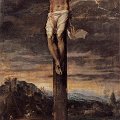
The painting was commissioned for the San Domenico in Ascona by the
Cornovi family, who had recently moved to Ancona from Venice.
Get a high-quality picture of
Crucifixion for your computer or notebook. ‣
The painting was commissioned for the San Domenico in Ascona by the
Cornovi family, who had recently moved to Ancona from Venice.
Though this was painted only a little later than the superb Crucifixion in the Escorial, there are already clear signs that Titian's style has progressed to the point where he is painting purely with colour. The scene with the mourners is taking place only in the foreground. The sky and the figures under the Cross are all painted in dark colours. Blue and black dominate the scene; white is used to produce dramatic highlights. Titian succeeds in representing St Dominic's sorrow as he embraces the Cross almost entirely by means of the distribution of light and the broad sweeping brushstrokes.
The stark placement of the three mourners in the immediate foreground, inviting us to share their suffering, makes this one of the first masterpieces of Counter-Reformation art, where narrative clarity and emotional empathy were denoted as artistic priorities. The Virgin and saints are arranged in a crescent, like the head of an anchor, at the base of the cross. On the left, the Virgin sways in solitary grief, while in the centre St Dominic, with exaggeratedly long fingers, feverishly clutches the base of the cross to draw strength. Christ, more fully illuminated than the others, is already beyond their reach, an effect Titian achieves by making him a little smaller than the rest and so creating a feeling of distance and separation. The blood which is pointedly depicted coursing along the sinews of his arms and down his side to soak into the loincloth also conforms to the taste and tenets of the Counter-Reformation.
Mater Dolorosa (1555)
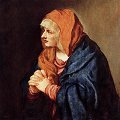 Get a high-quality picture of
Mater Dolorosa for your computer or notebook. ‣
One of numerous versions of this theme painted by Titian and his
workshop in the 1550s, this Mater Dolorosa with clasped hands is
particularly impressive because of the delicate colour scheme of the blue
cloak, pink garment, and saffron yellow veil. Inventories tell us that
Charles V also took a Madonna on wood, together with the Ecce Homo, with
him to the monastery of Yuste. Some authors assume that this is the work
in question.
Get a high-quality picture of
Mater Dolorosa for your computer or notebook. ‣
One of numerous versions of this theme painted by Titian and his
workshop in the 1550s, this Mater Dolorosa with clasped hands is
particularly impressive because of the delicate colour scheme of the blue
cloak, pink garment, and saffron yellow veil. Inventories tell us that
Charles V also took a Madonna on wood, together with the Ecce Homo, with
him to the monastery of Yuste. Some authors assume that this is the work
in question.
Portrait of the Doge Francesco Venier (1556)
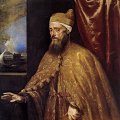 Get a high-quality picture of
Portrait of the Doge Francesco Venier for your computer or notebook. ‣
Francesco Venier (1490-1556) was elected Doge on 11 June 1554. He
reigned for scarcely two years, until 2 June 1556. This portrait is an
excellent example of the way Titian used colour during his late period.
The picture does not break up into countless colours. Only in the garment
is there a fine play of golden hues, underlining the delicacy of the frail
Doge. So far there has been no explanation for the fire in the lagoon,
which is visible through the window. In terms of colour, the fire provides
an important contrast with the blue sky.
Get a high-quality picture of
Portrait of the Doge Francesco Venier for your computer or notebook. ‣
Francesco Venier (1490-1556) was elected Doge on 11 June 1554. He
reigned for scarcely two years, until 2 June 1556. This portrait is an
excellent example of the way Titian used colour during his late period.
The picture does not break up into countless colours. Only in the garment
is there a fine play of golden hues, underlining the delicacy of the frail
Doge. So far there has been no explanation for the fire in the lagoon,
which is visible through the window. In terms of colour, the fire provides
an important contrast with the blue sky.
Entombment (1559)
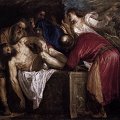 Get a high-quality picture of
Entombment for your computer or notebook. ‣
In the Entombment, the broader and more open brushwork that Titian
was now developing serves to trap the light and add a torrid and
glittering intensity to the colours. The dead weight of Christ's body
is accentuated by collapsing the rhythm of the figures towards the
left, resisted only by the bearded figure of Nicodemus. The latter has
Titian's features, as if the artist wanted to allocate to himself a
responsible role in the burial process, just as Michelangelo had
portrayed himself as Nicodemus in his unfinished Pieta of 1550 in
Florence Cathedral. The Gospels describe Christ's tomb as being
excavated out of rock, but in Titian's interpretation it takes the
form of a classical sarcophagus decorated with the Christian themes of
Cain and Abel and the Sacrifice of Isaac - Old Testament events
considered to prefigure the Crucifixion and Resurrection. The corner
of the sarcophagus projects into the very front of the picture plane
in a cutting analogy of the disciples' grief.
Get a high-quality picture of
Entombment for your computer or notebook. ‣
In the Entombment, the broader and more open brushwork that Titian
was now developing serves to trap the light and add a torrid and
glittering intensity to the colours. The dead weight of Christ's body
is accentuated by collapsing the rhythm of the figures towards the
left, resisted only by the bearded figure of Nicodemus. The latter has
Titian's features, as if the artist wanted to allocate to himself a
responsible role in the burial process, just as Michelangelo had
portrayed himself as Nicodemus in his unfinished Pieta of 1550 in
Florence Cathedral. The Gospels describe Christ's tomb as being
excavated out of rock, but in Titian's interpretation it takes the
form of a classical sarcophagus decorated with the Christian themes of
Cain and Abel and the Sacrifice of Isaac - Old Testament events
considered to prefigure the Crucifixion and Resurrection. The corner
of the sarcophagus projects into the very front of the picture plane
in a cutting analogy of the disciples' grief.
The motif of the Virgin holding the limp arm of Christ is inspired by Raphael's Entombment in the Villa Borghese and perhaps also by Aretino's Humanity of Christ.
Diana and Callisto (1559)
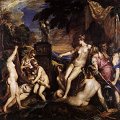 Get a high-quality picture of
Diana and Callisto for your computer or notebook. ‣
In his later career Titian, like Veronese, developed a greater
seriousness and expressive intensity, not only in his religious works, but
also in his pagan mythologies. The paintings Diana and Actaeon, and Diana
and Callisto were painted as part of a series of six large mythological
canvases (or poesie as Titian called them) for the principal patron of his
final years, King Philip II of Spain. A very general theme underlying the
series is that of the loves of the Olympian gods, and of the usually
tragic circumstances for any mortals who become involved with them. The
principal literary source for the paintings is Ovid's Metamorphoses, the
most popular work of classical literature in the Italian Renaissance.
Get a high-quality picture of
Diana and Callisto for your computer or notebook. ‣
In his later career Titian, like Veronese, developed a greater
seriousness and expressive intensity, not only in his religious works, but
also in his pagan mythologies. The paintings Diana and Actaeon, and Diana
and Callisto were painted as part of a series of six large mythological
canvases (or poesie as Titian called them) for the principal patron of his
final years, King Philip II of Spain. A very general theme underlying the
series is that of the loves of the Olympian gods, and of the usually
tragic circumstances for any mortals who become involved with them. The
principal literary source for the paintings is Ovid's Metamorphoses, the
most popular work of classical literature in the Italian Renaissance.
Diana's nymphs were expected to be as chaste as the goddess herself. One of them, Callisto, was seduced by Jupiter who first disguised himself as Diana in order to gain the nymphs presence. In Diana and Callisto, the unfortunate Callisto is shown being stripped by her companions at the command of the chaste goddess Diana to reveal her pregnancy. Banished for her shameful state, Callisto was transformed into a bear by Jupiter's jealous wife Juno, but was later immortalised by him as the constellation of the Great Bear.
In Titian's painting, Diana in her grotto confronts Callisto, her robes drawn aside to reveal an unmistakable pregnancy.
The pendants Diana and Acteon and Diana and Callisto (both on loan to the National Gallery of Scotland in Edinburgh) were formerly in the collection of Philippe Egalito, Duc d'Orleans. After the French Revolution they were purchased by the immensely wealthy Duke of Bridgewater and still belong to his descendants.
Portrait of a Man with a Palm (1561)
 Get a high-quality picture of
Portrait of a Man with a Palm for your computer or notebook. ‣
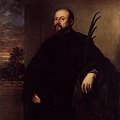
In spite of many speculative attempts, the identity of the sitter is
unknown.
Get a high-quality picture of
Portrait of a Man with a Palm for your computer or notebook. ‣
In spite of many speculative attempts, the identity of the sitter is
unknown.
Titian presents his sitter in an imposing manner as a dignitary whose face, with its penetrating gaze, does not to betray a flicker of emotion. The severity of the presentation is given a surprisingly lyrical counterweight in the form of the evening landscape to the left. The artist has worked here with open, more diffuse brush strokes, which in places allow the grey ground to show through. Titian was to make extensive use of this method in his late work, even to the extent of applying paint with his fingers.
Self-Portrait (1562)
 Get a high-quality picture of
Self-Portrait for your computer or notebook. ‣
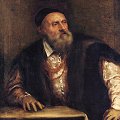
This painting has been given a variety of dates ranging from the early
1550s to the 1560s. The manner in which the white is applied as a thick
mass of paint in irregular and occasionally very large sections is
reminiscent of Titian's style in about 1560, but the painting was not
completed. There is only a suggestion of where his left hand is. It is
interesting that he omitted any reference to his occupation. The only
biographical allusion is the golden chain, the sign of his knighthood.
Get a high-quality picture of
Self-Portrait for your computer or notebook. ‣
This painting has been given a variety of dates ranging from the early
1550s to the 1560s. The manner in which the white is applied as a thick
mass of paint in irregular and occasionally very large sections is
reminiscent of Titian's style in about 1560, but the painting was not
completed. There is only a suggestion of where his left hand is. It is
interesting that he omitted any reference to his occupation. The only
biographical allusion is the golden chain, the sign of his knighthood.
Comparing this painting with the later self-portrait in the Prado, the latter shows Titian as withdrawn and distant in near profile, in contrast to the self-portrait in Berlin, where he appears without the tools of his trade but as if staring critically at an unseen canvas as described by Palma Giovane.
Death of Actaeon (1562)
 Get a high-quality picture of
Death of Actaeon for your computer or notebook. ‣
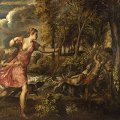
In the years following the execution of his two celebrated mythological
paintings, the Diana and Callisto, and the Diana and Actaeon, Titian
painted other mythological paintings for Philip II, including the Rape of
Europa (Museum of Fine Arts, Boston), the Death of Actaeon (National
Gallery, London), and Perseus and Andromeda (Wallace Collection,
London).
Get a high-quality picture of
Death of Actaeon for your computer or notebook. ‣
In the years following the execution of his two celebrated mythological
paintings, the Diana and Callisto, and the Diana and Actaeon, Titian
painted other mythological paintings for Philip II, including the Rape of
Europa (Museum of Fine Arts, Boston), the Death of Actaeon (National
Gallery, London), and Perseus and Andromeda (Wallace Collection,
London).
In the Death of Actaeon, the dramatic scene of the young hunter attacked and ripped apart by the pack of dogs takes place in a landscape of livid colours heavy with premonition.
Venus Blindfolding Cupid (1565)
 Get a high-quality picture of
Venus Blindfolding Cupid for your computer or notebook. ‣
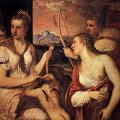
Titian's Venus Blindfolding Cupid evokes Cupid's blind power
as his mother, the cosmic divinity, blindfolds him. His brother is
intent on observing the large number of arrows or fatal darts of love
(a metaphor for amorous glances) the nymph is carrying.
Get a high-quality picture of
Venus Blindfolding Cupid for your computer or notebook. ‣
Titian's Venus Blindfolding Cupid evokes Cupid's blind power
as his mother, the cosmic divinity, blindfolds him. His brother is
intent on observing the large number of arrows or fatal darts of love
(a metaphor for amorous glances) the nymph is carrying.
This painting, in spite of the potentially joyous mythological subject and similarly to other works executed in this period, is pervaded with a degree of tension which is clearly evident in the sad and pensive expressions and in the intense colours of the fiery sky.
The rapid brush-strokes of Titian's mature pictorial technique when seen close to seem to break up the forms but from a distance they acquire an extraordinary modelled quality and create a chromatic texture that blends the background and figures in a 'Venetian' harmony of colours. In the 17th century this style influenced Velazquez, Rubens, van Dyck and Caravaggio.
Penitent St. Mary Magdalene (1565)
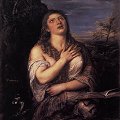 Get a high-quality picture of
Penitent St. Mary Magdalene for your computer or notebook. ‣
In 1561 Titian executed a painting of Mary Magdalen for Philip II, king
of Spain. It is lost but several other compositions, based on this
painting, survived; probably the best version is that in the Hermitage.
This painting is signed on the rock on the left side. In his final period
Titian handled his various versions of the Penitent Mary Magdalene with a
dramatic intensity. This is particularly evident in a comparison of the St
Petersburg canvas - considered the prototype for the series - with the
early Mary Magdalene (in the Palazzo Pitti, Florence) painted for the Duke
of Urbino in 1533.
Get a high-quality picture of
Penitent St. Mary Magdalene for your computer or notebook. ‣
In 1561 Titian executed a painting of Mary Magdalen for Philip II, king
of Spain. It is lost but several other compositions, based on this
painting, survived; probably the best version is that in the Hermitage.
This painting is signed on the rock on the left side. In his final period
Titian handled his various versions of the Penitent Mary Magdalene with a
dramatic intensity. This is particularly evident in a comparison of the St
Petersburg canvas - considered the prototype for the series - with the
early Mary Magdalene (in the Palazzo Pitti, Florence) painted for the Duke
of Urbino in 1533.
Despite the religious subject matter, there is a strong erotic quality in this picture of Mary Magdalene, who has sunk down in a posture of pious penitence, tears in her eyes as she gazes up to heaven. In contrast to the version painted for Francesco Maria della Rovere (now in the Palazzo Pitti, Florence), in this version her breasts are covered, but the extremely skimpy covering is if anything more provocative.
The painting was kept by Titian, and remained in his own house until he died. In 1581 his son Pomponio sold his entire remaining works to Cristoforo Barbarigo. In 1850, the Barbarigo collection was moved to the Hermitage. The work is particularly impressive because of the beauty of the colours and the wonderful play of the light - Titian depicts the changes of colour it creates right down to the shadows cast on Magdalene's breast by the cloth.
Christ and the Good Thief (1566)
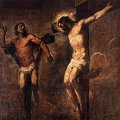 Get a high-quality picture of
Christ and the Good Thief for your computer or notebook. ‣
There is considerable disagreement about the attribution of this work
to Titian. While the manner in which the colours are applied is reminiscent
of his late work, the extraordinary spatial effect, which is mainly
produced by the turning of the thief's cross, can be observed in none of
his later works. The way the light falls would also be an unusual feature
in Titian's works in the 1560s. If this indeed is not one of his
paintings, it is nonetheless one of the highest quality examples of the
adoption of elements of his style by other artists.
Get a high-quality picture of
Christ and the Good Thief for your computer or notebook. ‣
There is considerable disagreement about the attribution of this work
to Titian. While the manner in which the colours are applied is reminiscent
of his late work, the extraordinary spatial effect, which is mainly
produced by the turning of the thief's cross, can be observed in none of
his later works. The way the light falls would also be an unusual feature
in Titian's works in the 1560s. If this indeed is not one of his
paintings, it is nonetheless one of the highest quality examples of the
adoption of elements of his style by other artists.
Spain Succouring Religion (1575)
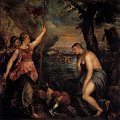 Get a high-quality picture of
Spain Succouring Religion for your computer or notebook. ‣
Among Titian's very last works, produced in 1575-76, two were official
commissions: one for the Palazzo Ducale, depicting Doge Antonio Grimani
Kneeling Before the Faith, and the second for Philip II, depicting Spain
Succouring Religion. The latter commemorates the participation of the
Spanish fleet at the Battle of Lepanto.
Get a high-quality picture of
Spain Succouring Religion for your computer or notebook. ‣
Among Titian's very last works, produced in 1575-76, two were official
commissions: one for the Palazzo Ducale, depicting Doge Antonio Grimani
Kneeling Before the Faith, and the second for Philip II, depicting Spain
Succouring Religion. The latter commemorates the participation of the
Spanish fleet at the Battle of Lepanto.
Philip II Offering Don Fernando to Victory (1575)
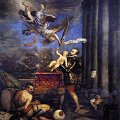 Get a high-quality picture of
Philip II Offering Don Fernando to Victory for your computer or notebook. ‣
The painting is an 'Allegory of the Battle of Lepanto'. On 7 October
1571 the combined allied fleets of Spain, the papacy and Venice, under the
supreme command of Don John of Austria, met and defeated the Ottoman fleet
in Greek waters at Lepanto (now Nafpaktos) in the Corinthian Gulf. It was
an extraordinary triumph for Christian arms with an enormous psychological
impact bringing relief to Christendom which had long felt beleaguered by
Islam. As the news spread across Europe, in Toledo a Te Deum was
celebrated in the great cathedral, Philip II endowed an annual procession
to commemorate the victory in perpetuity.
Get a high-quality picture of
Philip II Offering Don Fernando to Victory for your computer or notebook. ‣
The painting is an 'Allegory of the Battle of Lepanto'. On 7 October
1571 the combined allied fleets of Spain, the papacy and Venice, under the
supreme command of Don John of Austria, met and defeated the Ottoman fleet
in Greek waters at Lepanto (now Nafpaktos) in the Corinthian Gulf. It was
an extraordinary triumph for Christian arms with an enormous psychological
impact bringing relief to Christendom which had long felt beleaguered by
Islam. As the news spread across Europe, in Toledo a Te Deum was
celebrated in the great cathedral, Philip II endowed an annual procession
to commemorate the victory in perpetuity.
Crowning with Thorns (1576)
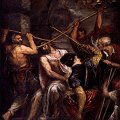 Get a high-quality picture of
Crowning with Thorns for your computer or notebook. ‣
In his final years Titian painted a series of paintings dedicated
to the passion of Christ. These works, which include the Crowning
with Thorns, are pervaded with immense dramatic power, the
brushstrokes gradually dissolve into rapidly applied dabs of pigment.
The aim is no longer to reproduce nature but to directly convey the
raw emotion of the painter, who is participating fully in the
tragic subject of his picture.
Get a high-quality picture of
Crowning with Thorns for your computer or notebook. ‣
In his final years Titian painted a series of paintings dedicated
to the passion of Christ. These works, which include the Crowning
with Thorns, are pervaded with immense dramatic power, the
brushstrokes gradually dissolve into rapidly applied dabs of pigment.
The aim is no longer to reproduce nature but to directly convey the
raw emotion of the painter, who is participating fully in the
tragic subject of his picture.
Pieta (1576)
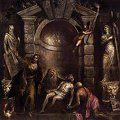 Get a high-quality picture of
Pieta for your computer or notebook. ‣
In his later works Titian's handling of colour is suffused with
spirituality; his youthful themes lose their Phidian serenity and from
the burning rhythm of interwoven tones which melt slowly into the
glowing tints images emerge, at times dramatic, at times full of
emotion for lost earthly happiness.
Get a high-quality picture of
Pieta for your computer or notebook. ‣
In his later works Titian's handling of colour is suffused with
spirituality; his youthful themes lose their Phidian serenity and from
the burning rhythm of interwoven tones which melt slowly into the
glowing tints images emerge, at times dramatic, at times full of
emotion for lost earthly happiness.
In his Pieta, originally planned for his tomb at the Frari and left unfinished at his death Titian achieves the high point of the expressive possibilities of his 'alchimia cromatica'. The work was completed by Palma il Giovane who added the torch-bearing cherub. The opaque density of this detail contrasts with the 'magical impressionism' of Titian's tonal harmonies. In the shimmering nocturnal scene figures of flesh and marble are evoked by a suffusion of glowing colour. And along the diagonal formed by the figures we are witness to an outpouring of human passion: Mary Magdalene turns in a cry of uncontrollable grief, the Virgin appears frozen in contemplation of her dead son and St. Jerome leans forward to catch the last breath of Christ.
Titian painted the Pieta when Venice was struck by plague. It was made as an ex voto offering, a prayer for the survival of himself and his beloved son, Orazio. In the bottom right-hand, propped under the stone lion, is a tablet on which Titian and Orazio are depicted praying to the Virgin for delivery from the plague. His plea went unanswered. Titian is recorded as having died "of fever" on August 27, 1576. Orazio also died during the plague.
The master of light here plunges into darkness, makes death's night visible. Glimmers of silvery torch - and moonlight on the mosaic canopy above Christ, on the statues of Moses and the Sybil, most of all the pale glowing flesh of the body of Christ accentuate the terrible gloom; it is overwhelming, and extremely personal.
Titian's terror makes the Christian images of redemption (that flicker of heavenly gold on the half-dome, the prophetic figures, the vegetation on the stone pediment) anything but reassuring. While the painting pleads for salvation, the emotional texture is of fear and horror: the closeness of death. The stone oppresses the mind; the statues are bodies frozen into stone, like a corpse with rigor mortis; the atmosphere of the painting is thickened, as if the air were poisoned.
This painting was offered by Titian to the Church of the Frari in a deal that would permit him a tomb there; he died with the painting unfinished, the deal unmade. It has the scale of an altarpiece, yet turned towards the night, a sombre pendant to his golden Assumption. Titian was a believer, and this painting is full of hints of resurrection - but the sense of dread makes it almost unbearable as Titian says farewell to light.
The Flaying of Marsyas (1576)
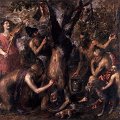 Get a high-quality picture of
The Flaying of Marsyas for your computer or notebook. ‣
Titian worked on this painting in the summer of 1576, when Venice was
devastated by a terrible plague which was to kill his favourite son
Orazio. The iconography derives from a Giulio Romano fresco of the same
subject in the Palazzo Te in Mantua, but Titian accentuates the terrifying
savagery of the mythological scene through the churning background of
ruddy browns, and the gloomy colours fitfully lit by sudden flashes of
light.
Get a high-quality picture of
The Flaying of Marsyas for your computer or notebook. ‣
Titian worked on this painting in the summer of 1576, when Venice was
devastated by a terrible plague which was to kill his favourite son
Orazio. The iconography derives from a Giulio Romano fresco of the same
subject in the Palazzo Te in Mantua, but Titian accentuates the terrifying
savagery of the mythological scene through the churning background of
ruddy browns, and the gloomy colours fitfully lit by sudden flashes of
light.
The meaning of the painting has been variously interpreted. It has been interpreted as the triumph of the divine art of Apollo and the stringed instrument over the rustic flute-playing satyr, or alternatively as representative of the spiritual cleansing brought about by the shedding of the Dionysian self. However, the presence of Titian himself, in the guise of King Midas, has favoured a reading of the painting as the painter's meditation on his own life.
Doge Antonio Grimani Kneeling Before the Faith (1576)
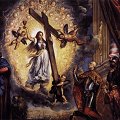 Get a high-quality picture of
Doge Antonio Grimani Kneeling Before the Faith for your computer or notebook. ‣
This painting is in the Sala delle Quattro Porte in the Palazzo
Ducale.
Get a high-quality picture of
Doge Antonio Grimani Kneeling Before the Faith for your computer or notebook. ‣
This painting is in the Sala delle Quattro Porte in the Palazzo
Ducale.
Though the painting was commissioned as early as 1555, it was not completed by the time Titian died. It is not only a votive picture for Doge Antonio Grimani (1436-1523), who is shown kneeling in front of a personification of the Faith, but is also a complex allegory of Venice. In the background the silhouette of the city is visible, and in the foreground St Mark, the patron saint of Venice, appears opposite the Doge. Most of the work was probably carried out by his workshop.
Titian Art
|
|
|
More
Articles
Art Encyclopedia A world history of art in articles.
Renaissance
Titian
Art and life.
Early art works by Titian.
Late art works by Titian.
Art
Art Wallpapers Art image collections for your desktop.
Della Francesca Art, $19
(95 pictures)
Da Vinci Art, $25
(80 pictures)
Michelangelo Art, $29
(180 pictures)
Raphael Art, $25
(125 pictures)
Titian Art, $29
(175 pictures)
Durer Art, $25
(120 pictures)
