Sistine Chapel
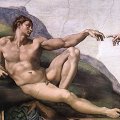 The Sistine Chapel (Cappella Sistina) is a chapel in
the Apostolic Palace, the official residence of the Pope, in the
Vatican City. Its fame rests on its architecture, which evokes the
Temple of the Old Testament, and its decoration, frescoed throughout
by the greatest Renaissance artists, including Michelangelo, whose ceiling is legendary. The Sistine Chapel is
considered to be the greatest artistic creation in the history
of mankind. Michelangelo could possibly be the greatest artist who has
ever lived. His paintings in Sistine Chapel, the triumph of
Renaissance humanist ideal, have changed the meaning of art
forever.
The Sistine Chapel (Cappella Sistina) is a chapel in
the Apostolic Palace, the official residence of the Pope, in the
Vatican City. Its fame rests on its architecture, which evokes the
Temple of the Old Testament, and its decoration, frescoed throughout
by the greatest Renaissance artists, including Michelangelo, whose ceiling is legendary. The Sistine Chapel is
considered to be the greatest artistic creation in the history
of mankind. Michelangelo could possibly be the greatest artist who has
ever lived. His paintings in Sistine Chapel, the triumph of
Renaissance humanist ideal, have changed the meaning of art
forever.
Seven Prophets
Seven prophets from the Old Testament were depicted on the ceiling, with Zechariah on the entrance end, Jonah on the chapel end, Joel, Ezechiel and Jeremiah on one of the long sides; and Isaiah and Daniel on the other. The four major prophets Jeremiah, Daniel, Ezekiel and Isaiah are diagonally opposite each other in that order from the chapel end towards the entrance, while the other three are seen as minor prophets.
- Sistine Chapel, Seven Prophets, Isaiah (1509)
- Sistine Chapel, Seven Prophets, Isaiah (Detail) (1509)
- Sistine Chapel, Seven Prophets, Joel (1509)
- Sistine Chapel, Seven Prophets, Joel (Detail) (1509)
- Sistine Chapel, Seven Prophets, Zechariah (1509)
- Sistine Chapel, Seven Prophets, Zechariah (Detail) (1509)
- Sistine Chapel, Seven Prophets, Ezekiel (1510)
- Sistine Chapel, Seven Prophets, Ezekiel (Detail) (1510)
- Sistine Chapel, Seven Prophets, Ezekiel (Detail 2) (1510)
- Sistine Chapel, Seven Prophets, Daniel (1511)
- Sistine Chapel, Seven Prophets, Daniel (Detail) (1511)
- Sistine Chapel, Seven Prophets, Jeremiah (1511)
- Sistine Chapel, Seven Prophets, Jeremiah (Detail) (1511)
- Sistine Chapel, Seven Prophets, Jonah (1511)
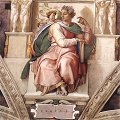
Sistine Chapel, Seven Prophets, Isaiah (1509)
 Get
Get  a high-quality picture of
Sistine Chapel, Seven Prophets, Isaiah for your computer or notebook. ‣
Isaiah is altogether different in character. He seems to listen
intently. His forehead may express bewilderment yet he is clad in the
green cloak of hope. As he listens, his genii point excitedly into the
distance whence the great voice addresses him. The powerful left arm
is raised as though commanding stillness or silence. He has an
intimation of the mystery of the Son. The naked feet are crossed, and
the entire figure expresses veneration, expectation and readiness.
What is the significance of the half closed book which he marks with
his inserted finger? Surely, that the book is nothing; books may fail,
the voice alone is infallible. Note how the contours of the figure
form a circle from which only the head and one hand emerge. The left
arm, the left hand, and the head together with the genii, describe an
oval superimposed on the circle. The face, with lips parted in
expectation, bears an expression of rapt attention; the hair of
indeterminate colour, and the vigorously drawn neck emerging from
light-toned draperies in blue, green and red, symbolizing faith, hope
and charity, indicate that this exalted figure is poised on the
threshold of two worlds; it is intent of hearing, it is rapt in
attention, and its genius points at Noah's offering.
a high-quality picture of
Sistine Chapel, Seven Prophets, Isaiah for your computer or notebook. ‣
Isaiah is altogether different in character. He seems to listen
intently. His forehead may express bewilderment yet he is clad in the
green cloak of hope. As he listens, his genii point excitedly into the
distance whence the great voice addresses him. The powerful left arm
is raised as though commanding stillness or silence. He has an
intimation of the mystery of the Son. The naked feet are crossed, and
the entire figure expresses veneration, expectation and readiness.
What is the significance of the half closed book which he marks with
his inserted finger? Surely, that the book is nothing; books may fail,
the voice alone is infallible. Note how the contours of the figure
form a circle from which only the head and one hand emerge. The left
arm, the left hand, and the head together with the genii, describe an
oval superimposed on the circle. The face, with lips parted in
expectation, bears an expression of rapt attention; the hair of
indeterminate colour, and the vigorously drawn neck emerging from
light-toned draperies in blue, green and red, symbolizing faith, hope
and charity, indicate that this exalted figure is poised on the
threshold of two worlds; it is intent of hearing, it is rapt in
attention, and its genius points at Noah's offering.
Above the Prophet to the left we see an ignudo with a jubilant expression. He and the blithe youth to the right above Daniel prove that Michelangelo - was he not the contemporary of the happy saint Filippo Neri? - was not altogether a stranger to joy.
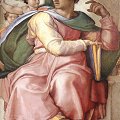
Sistine Chapel, Seven Prophets, Isaiah (Detail) (1509)
 Get a high-quality picture of
Sistine Chapel, Seven Prophets, Isaiah (Detail) for your computer or notebook. ‣
A prophet of the Passion, Isaiah has interrupted his reading of the
book, which he keeps open with his right hand. As if his attention
were being attracted by the boy behind him, he turns his face to the
left with an anguished expresseion. However, his eyes are not focused
on anything; the vision that disturbs him is an interior one, and his
tension is expressed by the way he contorts his limbs, which is
reflected in his head, shoulders, arms, and crossed feet. This
movement is stressed by the arc of the blue mantle lined with green
and the folds of the grayish-white robe and rose tunic.
Get a high-quality picture of
Sistine Chapel, Seven Prophets, Isaiah (Detail) for your computer or notebook. ‣
A prophet of the Passion, Isaiah has interrupted his reading of the
book, which he keeps open with his right hand. As if his attention
were being attracted by the boy behind him, he turns his face to the
left with an anguished expresseion. However, his eyes are not focused
on anything; the vision that disturbs him is an interior one, and his
tension is expressed by the way he contorts his limbs, which is
reflected in his head, shoulders, arms, and crossed feet. This
movement is stressed by the arc of the blue mantle lined with green
and the folds of the grayish-white robe and rose tunic.
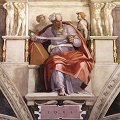
Sistine Chapel, Seven Prophets, Joel (1509)
 Get a high-quality picture of
Sistine Chapel, Seven Prophets, Joel for your computer or notebook. ‣
In Joel the state of inspiration, expressed by the light scrolls
unfurled like a pennon and the flaming hair, has taken the place of
acquired knowledge. The book is under the Prophet's feet, half hidden
by the steep folds of his garment. The genii flanking the magnificent
head re-enact the process: while one of them closes his book and
raptly gazes across the Prophet's shoulder, the other brings his folio
and acts as the devil's advocate and the spokesman of mere
intellectual learning. Joel's shock is emphasized by a shifting of his
body axis to the left. We find this grandiose diagonal movement again
in the other giants: in Ezekiel, Daniel, and even more pronounced in
Jonah. Joel in particular foresaw the coming of the Holy Ghost, and it
is as though he shrank back before the consuming flame by which he
none the less longs to be devoured. The lineal treatment of the Roman
head - giving it the air of the mighty poet whom the High Renaissance
failed to produce - carries to new heights the art form used by
Signorelli.
Get a high-quality picture of
Sistine Chapel, Seven Prophets, Joel for your computer or notebook. ‣
In Joel the state of inspiration, expressed by the light scrolls
unfurled like a pennon and the flaming hair, has taken the place of
acquired knowledge. The book is under the Prophet's feet, half hidden
by the steep folds of his garment. The genii flanking the magnificent
head re-enact the process: while one of them closes his book and
raptly gazes across the Prophet's shoulder, the other brings his folio
and acts as the devil's advocate and the spokesman of mere
intellectual learning. Joel's shock is emphasized by a shifting of his
body axis to the left. We find this grandiose diagonal movement again
in the other giants: in Ezekiel, Daniel, and even more pronounced in
Jonah. Joel in particular foresaw the coming of the Holy Ghost, and it
is as though he shrank back before the consuming flame by which he
none the less longs to be devoured. The lineal treatment of the Roman
head - giving it the air of the mighty poet whom the High Renaissance
failed to produce - carries to new heights the art form used by
Signorelli.
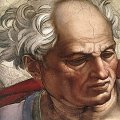
Sistine Chapel, Seven Prophets, Joel (Detail) (1509)
 Get a high-quality picture of
Sistine Chapel, Seven Prophets, Joel (Detail) for your computer or notebook. ‣
Wearing an ash-blue tunic with pink reflections and a red mantle,
Joel - the herald of terrible calamities on the earth and the
darkening of the sun and the moon in the sky - is portrayed frontally,
as he sits unwinding and reading a scroll. His intent face, framed by
locks of white hair, and the pose of his body express energy, together
with a degree of tension.
Get a high-quality picture of
Sistine Chapel, Seven Prophets, Joel (Detail) for your computer or notebook. ‣
Wearing an ash-blue tunic with pink reflections and a red mantle,
Joel - the herald of terrible calamities on the earth and the
darkening of the sun and the moon in the sky - is portrayed frontally,
as he sits unwinding and reading a scroll. His intent face, framed by
locks of white hair, and the pose of his body express energy, together
with a degree of tension.
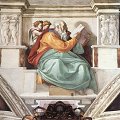
Sistine Chapel, Seven Prophets, Zechariah (1509)
 Get a high-quality picture of
Sistine Chapel, Seven Prophets, Zechariah for your computer or notebook. ‣
On entering the Chapel (generally through the east door, for
contrary to prevalent custom the altar with the 'Last Judgement'
occupies the west wall), one can see the Prophet Zechariah enthroned
above. In ecclesiastical tradition Zechariah is young, but
Michelangelo painted him as a man hoary with age, with a long beard
and an ample green cloak, perhaps indicative of the unfathomable depth
of his prophecies. This may be the earliest figure; it is extremely
powerful but still somewhat clumsy, hardly suggesting a being who has
received illumination. The old man is reading from his book, perhaps
reciting the passages on the reconstruction of the temple, which he
advocated.
Get a high-quality picture of
Sistine Chapel, Seven Prophets, Zechariah for your computer or notebook. ‣
On entering the Chapel (generally through the east door, for
contrary to prevalent custom the altar with the 'Last Judgement'
occupies the west wall), one can see the Prophet Zechariah enthroned
above. In ecclesiastical tradition Zechariah is young, but
Michelangelo painted him as a man hoary with age, with a long beard
and an ample green cloak, perhaps indicative of the unfathomable depth
of his prophecies. This may be the earliest figure; it is extremely
powerful but still somewhat clumsy, hardly suggesting a being who has
received illumination. The old man is reading from his book, perhaps
reciting the passages on the reconstruction of the temple, which he
advocated.
Some scholars thought that Julius II and his counselors took it as a reference to the rebuilding of Saint Peter's. Zechariah prophesied the coming of a king riding into Jerusalem on a donkey, that is, Palm Sunday; and the Descent of the Holy Ghost, the Pentecost - both of which played a prominent part in the Church ritual of the Vatican. A crest with the oak of the della Rovere is placed on the console of Zechariah. Twin genii peer over the shoulder of the Prophet with the book.
Zechariah was one of the twelve 'lesser' prophets. Michelangelo chose two more, Joel and Jonah, from among them, in addition to the four major prophets Isaiah, Jeremiah, Ezekiel and Daniel. The remaining thrones are occupied by five of the twelve traditional Sibyls.
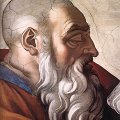
Sistine Chapel, Seven Prophets, Zechariah (Detail) (1509)
 Get a high-quality picture of
Sistine Chapel, Seven Prophets, Zechariah (Detail) for your computer or notebook. ‣
The imposing figure of the prophet was extensively repainted,
especially in the eighteenth century by Alessandro Mazzuoli. This
repainting was removed during the recent restoration.
Get a high-quality picture of
Sistine Chapel, Seven Prophets, Zechariah (Detail) for your computer or notebook. ‣
The imposing figure of the prophet was extensively repainted,
especially in the eighteenth century by Alessandro Mazzuoli. This
repainting was removed during the recent restoration.
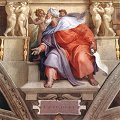
Sistine Chapel, Seven Prophets, Ezekiel (1510)
 Get a high-quality picture of
Sistine Chapel, Seven Prophets, Ezekiel for your computer or notebook. ‣
Ezekiel, the Prophet of the Merkabah, the divine throne and chariot
of fire, the heavenly hierarchy and the four cherubim, is shown
contorted by his vision. His expressive Hebrew profile faces Zechariah
to the left. There is surely some meaning in the fact that this
Prophet's head is wrapped in a white turban; holy dread is written on
his countenance - the brightness of the vision might have blinded him.
The other Prophets are bareheaded, while the Sibyls, like the young
Delphica and the old Persica, closer to earth, are veiled or shrouded
so as to protect them from an excess of light. The movement of the
Prophet's right hand indicates three things: surprise, self surrender,
and the imparting of his vision. Michelangelo thus succeeded by sheer,
direct simplicity, in endowing a simple gesture with manifold meaning.
The contrast of Ezekiel's sombre, heavy garment painted in brown and
lilac makes his rapture all the more poignant. The wind of the spirit
brushes the fringes on his shoulder. The earth-sprite behind the old
man looks terrified, while the beautiful and angelic boy beside him
points heavenward with a gesture reminding us of Leonardo's 'John the
Baptist' and his 'Bacchus'; late works which Michelangelo may not have
seen. But great men who are ahead of their time often express some new
idea simultaneously.
Get a high-quality picture of
Sistine Chapel, Seven Prophets, Ezekiel for your computer or notebook. ‣
Ezekiel, the Prophet of the Merkabah, the divine throne and chariot
of fire, the heavenly hierarchy and the four cherubim, is shown
contorted by his vision. His expressive Hebrew profile faces Zechariah
to the left. There is surely some meaning in the fact that this
Prophet's head is wrapped in a white turban; holy dread is written on
his countenance - the brightness of the vision might have blinded him.
The other Prophets are bareheaded, while the Sibyls, like the young
Delphica and the old Persica, closer to earth, are veiled or shrouded
so as to protect them from an excess of light. The movement of the
Prophet's right hand indicates three things: surprise, self surrender,
and the imparting of his vision. Michelangelo thus succeeded by sheer,
direct simplicity, in endowing a simple gesture with manifold meaning.
The contrast of Ezekiel's sombre, heavy garment painted in brown and
lilac makes his rapture all the more poignant. The wind of the spirit
brushes the fringes on his shoulder. The earth-sprite behind the old
man looks terrified, while the beautiful and angelic boy beside him
points heavenward with a gesture reminding us of Leonardo's 'John the
Baptist' and his 'Bacchus'; late works which Michelangelo may not have
seen. But great men who are ahead of their time often express some new
idea simultaneously.
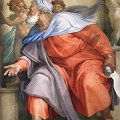
Sistine Chapel, Seven Prophets, Ezekiel (Detail) (1510)
 Get a high-quality picture of
Sistine Chapel, Seven Prophets, Ezekiel (Detail) for your computer or notebook. ‣
The vigorous figure of the prophet stands out clearly against the
light background. It is painted with clear brushstrokes, strong
contrasts of light and shade, and colour accords between the bright
red of the tunic and the colder tones of both the cloth wrapped around
his head and shoulders, and the mantle. The profile of the head is
depicted in detail, accentuating its expressiveness, while that of the
youth he appears to be addressing is rendered with soft glazes of
colour. The plasticity of the figure is magnificently represented by
the sculptural modeling, as well as by the neck and head, hands, and
feet.
Get a high-quality picture of
Sistine Chapel, Seven Prophets, Ezekiel (Detail) for your computer or notebook. ‣
The vigorous figure of the prophet stands out clearly against the
light background. It is painted with clear brushstrokes, strong
contrasts of light and shade, and colour accords between the bright
red of the tunic and the colder tones of both the cloth wrapped around
his head and shoulders, and the mantle. The profile of the head is
depicted in detail, accentuating its expressiveness, while that of the
youth he appears to be addressing is rendered with soft glazes of
colour. The plasticity of the figure is magnificently represented by
the sculptural modeling, as well as by the neck and head, hands, and
feet.
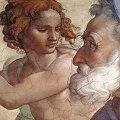
Sistine Chapel, Seven Prophets, Ezekiel (Detail 2) (1510)
 Get a high-quality picture of
Sistine Chapel, Seven Prophets, Ezekiel (Detail 2) for your computer or notebook. ‣
The profile of the head is depicted in detail, accentuating its
expressiveness, while that of the youth he appears to be addressing is
rendered with soft glazes of colour.
Get a high-quality picture of
Sistine Chapel, Seven Prophets, Ezekiel (Detail 2) for your computer or notebook. ‣
The profile of the head is depicted in detail, accentuating its
expressiveness, while that of the youth he appears to be addressing is
rendered with soft glazes of colour.
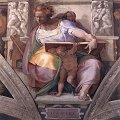
Sistine Chapel, Seven Prophets, Daniel (1511)
 Get a high-quality picture of
Sistine Chapel, Seven Prophets, Daniel for your computer or notebook. ‣
If Ezekiel saw the beginning and the origin of creation, the first
emanation of the Godhead, the youthful Titan Daniel knows of ultimate
things and of the Judgement which Michelangelo was to paint much later
above the altar of the Sistine Chapel. Assisted by his genius half
hidden in his lilac mantle, the man who lived unharmed in a lion's den
silently sets down in the Book of Life what he has seen. The seer's
hand with the foreshortened arm expresses quiet dedication to his
task. And it should be said here that Michelangelo's vaunted
foreshortening perspectives were never feats of artistic bravado, as
was the case with his countless imitators, but always met a
psychological necessity or expressed some truth; they are therefore
aesthetically satisfying, never grotesque as so often in Baroque
art.
Get a high-quality picture of
Sistine Chapel, Seven Prophets, Daniel for your computer or notebook. ‣
If Ezekiel saw the beginning and the origin of creation, the first
emanation of the Godhead, the youthful Titan Daniel knows of ultimate
things and of the Judgement which Michelangelo was to paint much later
above the altar of the Sistine Chapel. Assisted by his genius half
hidden in his lilac mantle, the man who lived unharmed in a lion's den
silently sets down in the Book of Life what he has seen. The seer's
hand with the foreshortened arm expresses quiet dedication to his
task. And it should be said here that Michelangelo's vaunted
foreshortening perspectives were never feats of artistic bravado, as
was the case with his countless imitators, but always met a
psychological necessity or expressed some truth; they are therefore
aesthetically satisfying, never grotesque as so often in Baroque
art.
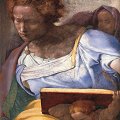
Sistine Chapel, Seven Prophets, Daniel (Detail) (1511)
 Get a high-quality picture of
Sistine Chapel, Seven Prophets, Daniel (Detail) for your computer or notebook. ‣
The figure of the prophet Daniel, engrossed in reading and writing,
but with the signs of deep interior anxiety, was seriously damaged by
water seepage and subsequent heavy retouching. The recent restoration
has revived the delicate colour accords of the clothes.
Get a high-quality picture of
Sistine Chapel, Seven Prophets, Daniel (Detail) for your computer or notebook. ‣
The figure of the prophet Daniel, engrossed in reading and writing,
but with the signs of deep interior anxiety, was seriously damaged by
water seepage and subsequent heavy retouching. The recent restoration
has revived the delicate colour accords of the clothes.
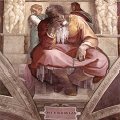
Sistine Chapel, Seven Prophets, Jeremiah (1511)
 Get a high-quality picture of
Sistine Chapel, Seven Prophets, Jeremiah for your computer or notebook. ‣
The melancholy, abstracted Jeremiah, more than any other figure, is
a deeply moving moral self portrait. Sorrowful unto death, he rests
from his spiritual vision, to reflect on the hardship and frustration
of earthly existence. We share the artist's pity for this noble being,
prematurely aged and steeped in the anguish of the universe who, alone
among the Prophets, must carry the weight of earthly existence. His
hand grasps his beard with a saturnine gesture that seems to be second
nature to him. The genii of Jeremiah are the strangest of the whole
series. The one to the left is feminine and, as it were, an image of
the Prophet's afflicted soul, painfully conscious of the absence of
pure goodness and beauty on the earthly plane, unless it be in art;
and even that was all too often suspect to the zealous among Christian
and Jewish communities where iconoclasm was forever lurking in the
dark recesses of the mind. In short, the genius is a symbol of
Platonism defeated in Michelangelo's youth by Savonarola. Platonism
itself found expression in the most sublime among the ignudi on the
Prophet's left. The shaping of the limbs the perfect torso and
magnificent, calmly musing profile surpass, if that be possible, the
Greek ideal of beauty. The monkish, hooded figure on the Prophet's
right is an unmistakable allusion to Savonarola; to the summons of
duty and conscience, to the injunction not to linger unduly in the
realms of Greek art. That is why the ignudo above resembles a bent
Atlas straining under the weight of his cornucopia, bearing a world
that casts a shadow upon his shoulders.
Get a high-quality picture of
Sistine Chapel, Seven Prophets, Jeremiah for your computer or notebook. ‣
The melancholy, abstracted Jeremiah, more than any other figure, is
a deeply moving moral self portrait. Sorrowful unto death, he rests
from his spiritual vision, to reflect on the hardship and frustration
of earthly existence. We share the artist's pity for this noble being,
prematurely aged and steeped in the anguish of the universe who, alone
among the Prophets, must carry the weight of earthly existence. His
hand grasps his beard with a saturnine gesture that seems to be second
nature to him. The genii of Jeremiah are the strangest of the whole
series. The one to the left is feminine and, as it were, an image of
the Prophet's afflicted soul, painfully conscious of the absence of
pure goodness and beauty on the earthly plane, unless it be in art;
and even that was all too often suspect to the zealous among Christian
and Jewish communities where iconoclasm was forever lurking in the
dark recesses of the mind. In short, the genius is a symbol of
Platonism defeated in Michelangelo's youth by Savonarola. Platonism
itself found expression in the most sublime among the ignudi on the
Prophet's left. The shaping of the limbs the perfect torso and
magnificent, calmly musing profile surpass, if that be possible, the
Greek ideal of beauty. The monkish, hooded figure on the Prophet's
right is an unmistakable allusion to Savonarola; to the summons of
duty and conscience, to the injunction not to linger unduly in the
realms of Greek art. That is why the ignudo above resembles a bent
Atlas straining under the weight of his cornucopia, bearing a world
that casts a shadow upon his shoulders.
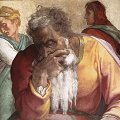
Sistine Chapel, Seven Prophets, Jeremiah (Detail) (1511)
 Get a high-quality picture of
Sistine Chapel, Seven Prophets, Jeremiah (Detail) for your computer or notebook. ‣
Deep in sorrowful meditation and oppressed by the terrible anguish
of his ominous predictions, Jeremiah leans forward, resting his bowed
head on his hand and his elbows on his spread knees. The expression of
the attendant on the left is also woeful, while the one on the right
was repainted in the past, together with part of the prophet's hair,
following serious damage caused by seepage of water.
Get a high-quality picture of
Sistine Chapel, Seven Prophets, Jeremiah (Detail) for your computer or notebook. ‣
Deep in sorrowful meditation and oppressed by the terrible anguish
of his ominous predictions, Jeremiah leans forward, resting his bowed
head on his hand and his elbows on his spread knees. The expression of
the attendant on the left is also woeful, while the one on the right
was repainted in the past, together with part of the prophet's hair,
following serious damage caused by seepage of water.
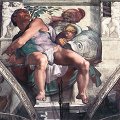
Sistine Chapel, Seven Prophets, Jonah (1511)
 Get a high-quality picture of
Sistine Chapel, Seven Prophets, Jonah for your computer or notebook. ‣
God allows the youthful Jonah, the seer of Nineveh whom he rescued
from the belly of the whale within three days - the time between
Christ's death and his resurrection, - to challenge him in his bold
nakedness, The figure mocks every law of composition and perspective.
Michelangelo conceived Jonah as an Old Testament Prometheus touched by
grace and presents us with a solution to the riddle of good and evil.
An artist, himself a rebellious Titan, proffers a solution that spells
deliverance in what may be the grandest piece of dialectical theology
ever stated in terms of art. The rebellious Prophet, whom God would
not have otherwise, looks up directly at his self begetting and
affirming Maker. In his expression, scorn and rebellion are giving
place to joy, delight, love and filial response, and the ecstatic
contemplation of God. The monster of the sea, the calabash tree of the
texts, and the turbulent genii form an animated background, unusually
bucolic and idyllic for Michelangelo.
Get a high-quality picture of
Sistine Chapel, Seven Prophets, Jonah for your computer or notebook. ‣
God allows the youthful Jonah, the seer of Nineveh whom he rescued
from the belly of the whale within three days - the time between
Christ's death and his resurrection, - to challenge him in his bold
nakedness, The figure mocks every law of composition and perspective.
Michelangelo conceived Jonah as an Old Testament Prometheus touched by
grace and presents us with a solution to the riddle of good and evil.
An artist, himself a rebellious Titan, proffers a solution that spells
deliverance in what may be the grandest piece of dialectical theology
ever stated in terms of art. The rebellious Prophet, whom God would
not have otherwise, looks up directly at his self begetting and
affirming Maker. In his expression, scorn and rebellion are giving
place to joy, delight, love and filial response, and the ecstatic
contemplation of God. The monster of the sea, the calabash tree of the
texts, and the turbulent genii form an animated background, unusually
bucolic and idyllic for Michelangelo.
Michelangelo Art
|
|

More
Articles
Art Encyclopedia A world history of art in articles.
Renaissance
Michelangelo
Art, life and biography.
Michelangelo's David.
Michelangelo's Pieta.
Sistine Chapel. High Renaissance Masterpiece.
Sistine Chapel. Book of Genesis.
Sistine Chapel. The Ignudi.
Sistine Chapel. Seven Prophets.
Sistine Chapel. Five Sibyls.
Sistine Chapel. Lunettes.
Sistine Chapel. Pendentives.
Sistine Chapel. The Ancestors of Christ.
Sistine Chapel. The Last Judgement.
Art
Art Wallpapers Art image collections for your desktop.
Della Francesca Art, $19
(95 pictures)
Da Vinci Art, $25
(80 pictures)
Michelangelo Art, $29
(180 pictures)
Raphael Art, $25
(125 pictures)
Titian Art, $29
(175 pictures)
Durer Art, $25
(120 pictures)
